

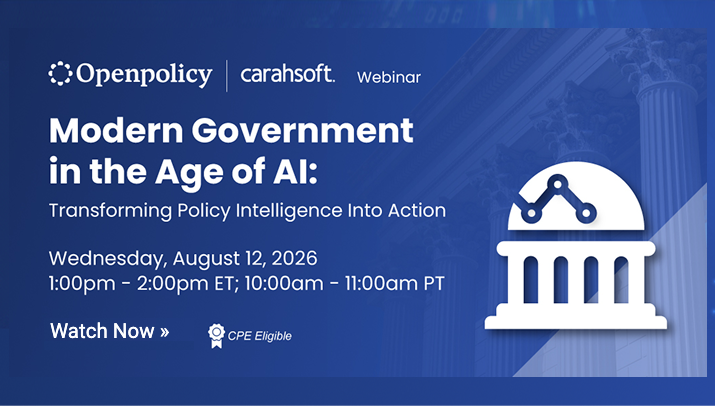
Watch the Webinar: Modern Government in the Age of AI — Turning Policy Intelligence Into Action
Register HERE to watch the full webinar
Policy is constantly shaping how government agencies operate—from cybersecurity and AI to acquisition, modernization, budgeting, and compliance. But as the volume and pace of policy change accelerate, simply keeping track of new directives, executive orders, standards, and regulations is no longer enough.
The opportunity for government is to use AI to understand what matters, why it matters to the mission, and what to do next.
In the recent OpenPolicy and Carahsoft webinar, “Modern Government in the Age of AI: Transforming Policy Intelligence Into Action,” OpenPolicy Co-Founder and CEO Dr. Amit Elazari explored how AI can transform policy from a largely reactive function into a proactive intelligence layer across government.
From Policy Awareness to Mission Action
Government agencies operate within an increasingly complex policy environment. Executive orders, agency guidance, standards, regulations, budget decisions, and operational directives can all affect the same mission simultaneously—and developments around AI, cybersecurity, quantum, acquisition, and other technology areas increasingly cut across agencies and jurisdictions.
The challenge is not simply finding policy information. It is identifying the developments that matter to a particular agency and connecting them to the decisions already being made across the organization.
As Amit explained during the webinar, this requires moving beyond policy as news and creating a continuous path from signal to prioritization to action.
With AI-powered policy intelligence, agencies can begin to:
- Anticipate change earlier. Identify emerging policies and requirements before they create operational urgency.
- Connect policy to mission context. Understand how developments affect specific programs, technology environments, procurement decisions, budgets, and strategic priorities.
- Identify gaps and alignment opportunities. Compare emerging requirements against existing policies, documentation, architectures, and organizational priorities.
- Reduce duplication across government. Surface related initiatives and policies across agencies to improve coordination and identify opportunities for reciprocity.
- Turn intelligence into action. Move from knowing that something changed to understanding its impact and identifying the next steps for the people responsible for acting on it.
These themes reflect what OpenPolicy is hearing directly from government agencies: the need for broader visibility across policy sources, continuous alignment and reciprocity checks, and greater foresight for decisions around procurement, technology architecture, budgets, and compliance.
AI Can Bring Policy Intelligence Beyond the Policy Office
One of the biggest opportunities discussed during the webinar is making policy intelligence useful beyond traditional policy teams.
Policy decisions increasingly affect CIOs, CISOs, procurement teams, program managers, acquisition leaders, technology teams, and other mission owners. Yet those professionals cannot be expected to continuously monitor the hundreds of sources that could affect their work.
AI provides an opportunity to scale policy expertise across the organization—giving more teams access to relevant, contextualized policy intelligence without requiring every user to become a policy expert.
That is particularly important because one of government's hardest policy problems is often what teams don't know they need to look for. An agency can respond to an executive order or requirement it already knows about. The greater challenge is proactively surfacing the policy development that a team did not know to search for but that could materially affect its mission.
Policy as a Strategic Opportunity
The webinar also challenged the idea that policy should primarily be viewed as a constraint or compliance requirement.
Understanding policy earlier gives agencies an opportunity to plan more strategically, anticipate requirements, make better technology and architecture decisions, coordinate with other agencies, and engage industry at the right time.
As Amit emphasized, whether a policy represents a risk or an opportunity depends on its specific impact on the organization. The same development may create a requirement for one program while opening a strategic opportunity for another. Context is what makes that distinction possible.
That shift—from reacting to policy after it arrives to continuously understanding its implications—is at the heart of modern policy intelligence.
Watch the Full Webinar
Modern Government in the Age of AI explores how government agencies can use AI-powered policy intelligence to anticipate change, strengthen policy alignment, reduce duplication, and move faster from emerging developments to mission action.
The discussion also includes a look at the OpenPolicy platform and how OpenPolicy is building AI-powered capabilities around policy monitoring, prioritization, gap analysis, trend analysis, and action-oriented intelligence for government agencies.
Register HERE to watch the full webinar

.png)